Be yourself; Everyone else is already taken.
— Oscar Wilde.
This is the first post on my new blog. I’m just getting this new blog going, so stay tuned for more. Subscribe below to get notified when I post new updates.
The Effect of Music on Young People’s Wellbeing
by Ian Parker
Be yourself; Everyone else is already taken.
— Oscar Wilde.
This is the first post on my new blog. I’m just getting this new blog going, so stay tuned for more. Subscribe below to get notified when I post new updates.

Imagine being a youth in a school or community who has trouble communicating and making friends because they are not too confident, and are afraid of being judged. If only there was some sort of medium that could open these people up and bring them closer to their community… There is!
Music can be a very effective way for anyone to feel included in a community, it makes people feel good, and feel good together. Music can be used as a mutual language to allow outsiders to engage with community members and vice-versa (Anthony 85). Music can help break the barrier between people who may have otherwise never talked to each other. The problem is that our school boards fail to recognize a benefit like this from music. Music is so common now-a-days that it is easily overlooked when it comes to using it to better one’s wellbeing. Without the knowledge that participating in music actually does have a range of benefits, schools fail to recognize the importance of music programs, and our youth cannot use these benefits to their advantage. Along with helping young people improve their social functioning, participating in music can also boost their emotion and mood, and help children learn easier. Music can play a huge role in improving our youth’s well-being, especially if they are able to participate in it on an everyday basis.
It should not be a surprise to hear that the state of your emotions and mood on a day to day basis will directly affect your overall well-being. Since this is the case, it is important for young people to have a way to regulate their mood in a way that will benefit their well-being the most. In “Young People’s Uses of Music for Well-Being,” Zoe Papinczak et al. state that “After exercise, music is the second most commonly used mood regulation strategy in young people and has the potential to assist them with achieving their optimal functioning and well-being” (Papinczak 1120). Music is helping young people control and regulate their emotions, and the ease of access to it makes it an extremely effective method. With music having this much potential for regulating young people’s mood, it does not get the praise that it should, especially since it takes much less effort to sit back and listen to some good music than it would to exercise. With that being said, it is important that we implement music into the everyday lives of our children, so they will be able to take advantage of its mood boosting effects. We can achieve this fairly easily through the school system, something as simple as having a music class for children to participate in every day could completely change the future of a child’s well-being.
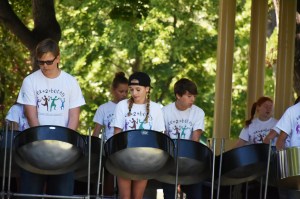
Music has also been proven to generally improve mood and reduce negative feelings. Kim Flores et al. conducted a study titled “Drumming as a Medium to Promote Emotional and Social Functioning of Children in Middle Childhood in Residential Care,” where children in a day care were put into a drumming program. The children they selected were between seven to twelve years old, and were reported by teachers and therapists to show high levels of depression, anxiety, anger, and or difficulties with social interaction (Flores 258). During the workshops, the children would play the drums to work on their rhythm skills and musical confidence. After gathering some results, Flores et al. tell us that “Participants derived pleasure and satisfaction from drumming which appeared to enhance the overall mood of the group, evidenced by reduced anger, depression and anxiety during workshops. Similar findings are reported by Ho et al., who assert that regular sessions of group drumming were found to reduce symptoms of withdrawal, depression, defiance, inattention and anxiety” (Flores 260). With these mood boosting, depression and anxiety reducing properties coming from something that children actually enjoy doing, it would be foolish of us not to take advantage of it. The children could use a drumming session like this as something they look forward to when they wake up in the morning, a fun session to brighten up their mood, and decrease levels of anxiety, anger, and depression that have built up throughout the day.
Part of the reason why music works as such a good treatment for children in need is because it is fun to them, they actually enjoy it. Now, just because something is “fun” doesn’t mean that it is necessarily good for a child, but Flores goes on to say “While ‘having fun’ is not typically cited as a therapeutic outcome, it is a vital part of normal child development and is fundamental to a child’s emotional well-being” (Flores 261). It is important for a child to experience these “fun” moments during their childhood. It is great that it works out this way because the children will actually want to do the activity that is helping them. The child’s interest is one of the most important parts when it comes to activities like this, because if the child is not interested, they will have a negative attitude towards the situation as a whole, and will likely not experience the potential benefits it has in store for them. Flores et al. say that “Possibly the most outstanding observation was children’s enjoyment of the sessions. The group under consideration included five children with very different temperaments and, initially, widely disparate affective states. Thandi presented with extreme levels of anger and depression. She often entered the workshops sullen and agitated. However, once sessions commenced and she was free to pound on her drum, her negativity diminished visibly. Such effects were increasingly evident as sessions progressed” (Flores 260). It is truly amazing that something as simple as playing the drums can take away a child’s extreme levels of anger and depression, and will have the child waiting for the next time they can play again.
On top of this, Flores et al. also note that the effects of the workshop were increasingly stronger each time they came back! Meaning the more the children participate, the more they will reap the beneficial effects from the workshops. Flores et al. say “Workshops enhanced participants’ emotional functioning in important ways. Improvements were cumulative in nature and enhanced emotional adaptation, as described below, was increasingly apparent with each successive workshop. Emergent themes included advances in positive affect, emotional regulation and playfulness; self-awareness, sense of self, self-expression and catharsis; and personal agency, self-motivation, mastery and self-confidence” (Flores 260). The children participating are becoming more in touch with themselves, being able to express their emotions and doing so confidently, all while enjoying the process at the same time. Having said this, remember that if these children keep coming back to the sessions, the effects music has on them will continue to increase. If all children were able to participate in programs like this daily, the state of their emotions on a day to day basis would be far better than if they were to not to participate, causing their overall well-being to increase.
Along with a boost in emotion and mood, music does a wonderful job improving social functioning and making people feel included. Susan Hallam et al. studied several different events where people were engaging in music in community settings in a study titled “Perceived Benefits of Active Engagement with Making Music in Community Settings.” During the study, the observers noticed that “through collaborative music-making, participants developed a deep sense of being connected with other group members” (Hallam 165). It is important for children to connect with their peers, and with music providing this strong feeling of connection, it can help them form relationships much easier. With the recent increase in technology, there have been less activities that children participate in that allow them to actually connect with each other in a real life setting. Music is the thing that is bringing all of these members together, and is also what is opening them up to each other. Hallam et al. continue to say “The social benefits noted by facilitators ranged from opportunities for meeting people to developing social skills and fostering mutually beneficial intergenerational relationships” (Hallam 165). Forming new relationships can have a tremendous effect on a child’s development, meeting new people means seeing new perspectives, different ways of thinking. On top of that, if some of these people are from different generations, this could be a great opportunity for a child to understand how people from different generations might think differently, since they were raised in times that are different than today. Music provides people with a setting to be social, while making them feel comfortable and welcome to communicate.
Music can also improve social functioning by giving children a boost in self-esteem and confidence. Brendon Anthony et al. held a study titled “Thumbs Up: The Effective Use of Music in Health and Well-Being Education for Australian Aboriginal Youth in Remote Communities,” where Australian Aboriginal youth were observed during sessions of a program called the Uncle Jimmy Thumbs Up (UJTU) program. This program was designed to help improve the health and well-being of certain indigenous communities by implementing song-writing, music, video, and new media into schools (Anthony 72). At the end of the program, Anthony et al. say that the youth feel more empowered, with a boost in confidence and self-esteem, which makes it more likely for them to engage functionally with their community (Anthony 85). The problem that these people were having before these sessions is that they felt disconnected from the community, they felt like they didn’t have something that they need to fit in. Music does a great job in assisting them to get rid of this feeling so they can truly express themselves. Anthony et al. continues on to say “Music has the ‘potential to bring a community together, bring attention to an issue, offer catharsis and to overcome language and cultural barriers’” (Anthony 82). Music can dissolve the barriers between people and allow them to connect with each other. Social functioning during a child’s development process can play a big role in the future of that child’s well-being, and the presence of music can allow them to make social interactions much easier than without it.
On top of boosting mood and improving social functioning, music has been proven to improve learning skills in children. A study done by Peter Gouzouasis, through the University of British Columbia, shows that children who take music courses display significantly higher scores on math, science, and English exams (Lok). “…the more the students engage with music, the better they do in those subjects” Gouzousasis told the reporter, “The students who learned to play a musical instrument in elementary and continued playing in high school not only score significantly higher, but were about one academic year ahead of their non-music peers with regard to their English, mathematics and science skills, as measured by their exam grades, regardless of their socioeconomic background, ethnicity, prior learning in mathematics and English, and gender” (Lok). An effect like this can literally be life changing, many people’s lives are drastically changed based on their performance in school. Most of the time, the better they do in school, the better the chance they have in becoming wealthy and doing what they actually want to do in life. It is incredible that music can influence a change like this, irrespective of many other factors like socioeconomic background and ethnicity. We need things in our society that will benefit everyone, not only specific groups. Gouzousasis continues to tell the reporter “A student has to learn to read music notation, develop eye-hand-mind coordination, develop keen listening skills, develop team skills for playing in an ensemble and develop discipline to practice. All those learning experiences, and more, play a role in enhancing the learner’s cognitive capacities, executive functions, motivation to learn in school, and self-efficacy” (Lok). The thing about music is that it is not necessarily easy to play, it requires a lot of focus and effort to become good at, but it provides the person playing with the motivation they need to actually learn all of the required skills to help them play well. Children developing all of the skills needed to become good at music will experience brain development that they would have otherwise never experienced, which will help them excel in an academic setting.
Music does a great job of giving a better understanding on how practice works to improve skill. An article written by Lauren Julius Harris, titled “Does Music Matter? A Look at the Issues and the Evidence” talks about how the understanding of development of skills is very important to properly develop skills in the future. Harris says “for studies of the effects of music training on transfer, an often unstated premise is that the greater the skill (as indexed in some correlational studies by years of training), the greater the likelihood of transfer and that skill and practice are more-or-less directly related” (Harris 113). What this is saying is that if someone practices a lot, and becomes good at playing music, they will credit their success to the time and effort they spent practicing it. Understanding that practice is what really develops skill is important for anyone to know, especially children that are developing and learning how to improve their skills, like math or English for example. If a child can understand that practice is what will get them to where they need to be, then they will practice appropriately to get the results that they really want. This information is crucial, and some people never learn it, thinking that people are just good at things naturally, instead of acknowledging the time and effort spent practicing needed to get to where they are. Harris continues to say “No one denies that practice is vital for acquisition of skill, including skill in music performance. The practice, however, must be what K. Anders Ericsson calls “deliberate,” consisting of highly-structured activities designed to improve performance through immediate feedback and requiring high concentration” (Harris 113).
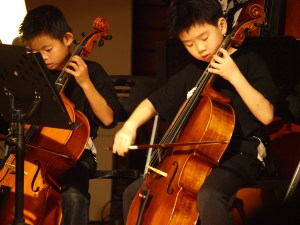
While learning to play music, very focused practicing takes place, where the learner is receiving instant feedback from them self. The learner is playing the instrument, while hearing and judging them self at the exact same time, causing them to constantly be aware of the mistakes that they are making, and to improve on them the next time around. This process can cause the learner to improve very quickly, and take in a deeper understanding of how practice is working to improve their skill. With this better understanding on how crucial practice is, the child will, in theory, understand what they need to do to become better in the areas where they struggle the most in school. A child might understand that they need to spend more time studying and practicing math, for example, to improve on their skill, just as they would with trying to become better at playing the violin. Understanding the effects of practice can help improve the motivation a child has towards school and studying, which will consequently improve their performance in class.
Music can also help children with learning disabilities have an easier time learning. According to an article by University College London, up to ten percent of the population suffers from learning disabilities (University College London). This means that about one in every ten students in a school suffer from learning disabilities, and we should do everything we can to help them work through their disadvantage. Graham Welch and Adam Ockelford wrote an article titled “The Importance of Music in Supporting the Development of Children with Learning Disabilities”. During this article the authors say that “The findings of two national surveys of 52 schools, supplemented by case study visits, demonstrated that many of those working with children with learning difficulties and autism regarded music as an essential ingredient in the children’s lives, both as a worthy focus of attention and source of pleasure in its own right, as well as a means of promoting wider learning and development” (Welch 23). When these children participate in musical interactions, they are increasing brain activity, while enjoying the process at the same time. Children with learning disabilities or autism have a difficulty focusing, and music can help them obtain the level of interest they need to keep them focused. That being said, Welch and Ockelford go on to say “Engaging in active music learning over a sustained period generates measurable physical, psychological and social benefits (as well as cultural benefit) that are long-term for the individuals and groups involved” (Welch 23). As long as the children remain focused, they are able to reap these benefits, which can be crucial to the development of children with these types of disabilities. Social and cultural benefits can tremendously help these children as they are usually lacking in these areas. To expand on this, Welch and Ockelford also say that “Teachers and parents reported significant nonmusical benefits as one of the outcomes of their children’s participation in musical activity, including heightened interpersonal communication skills, more focused, attentive behaviour, sensory and cognitive development, physical development and intensified social participation” (Welch 23-24). All of the benefits that music seems to be providing will certainly affect the well-being of these children. Improving on areas like these can cause tremendous changes in their day to day life. It is crazy to think that something as simple as music can influence changes like these, but the evidence shows that it really can, and it is important that we take the correct action to get the full potential out of programs like these in schools.
I know what you, as the reader, are probably thinking, “Don’t the majority of schools already make kids take a music class?” And you’re right, the majority of schools do. But according to the Grammy Music Education Coalition, 3.8 million children across the United States do not have access to a music program at their school (Strauss). The problem is that schools are cutting the programs due to a lack of funds, because they do not understand how important music can be for developing children. Peter Gouzouasis says “Often, resources for music education are cut or not available in elementary and secondary schools so that they could focus on math, science and English”…”The irony is that music education can be the very thing that improves all-around academic achievement and an ideal way to have students learn more holistically in schools” (Lok). If we could raise enough awareness of the beneficial effects that music can provide to our youth, maybe the schools would stop cutting funding for these programs. Joseph Pergola, the Director of Fine Arts at NESCO, says that “we must face the fact that we, collectively and as individuals, have not done a good enough job communicating the value of music education for our children’s future and for our nation. We have not effectively communicated and convinced the academic world, society in general, the people who control the levers of influence and the people who make the critical decisions regarding educational funding for the arts” (Pergola). He is most certainly right. We as a community have not done the job that we need to do to let the world know important music really is. Music can and has done wonderful things for people, yet it remains in a position where it is not given the credit that it deserves, causing children everywhere to miss out on an opportunity that could change their life.
It is also important to note that the problem isn’t just that some children don’t have access to a music program, but the current programs provided do not supply the children with the quality of instruction that they need to obtain the benefits that have been discussed throughout this paper. In some schools, the children only receive music education once a week, and it usually isn’t quality education because the instructors do not have enough time to teach everything they would like to. The current funding for music programs simply does not provide schools with the capital they need to take advantage of the benefits that music has the potential to provide, and yet the school boards continue to cut more money from music programs. Pergola says “Too many school boards believe that cutting or eliminating music programs will ease budget restraints with little or no detrimental effect on students. It is the responsibility of every music education advocate to be able to effectively dispute this claim” (Pergola). It is our job to inform these board members of the true potential that music programs can have on the future of our youth’s success in the classroom, as well as their overall wellbeing.

Music in today’s society is very relevant and is present almost everywhere. This is great because music can provide a variety of benefits for the people who choose to engage in it. Music has the ability to improve one’s mood and enhance their emotions, giving the participant a way to regulate their mood on a day to day basis. Music can also improve one’s social functioning, allowing them to connect with their peers, and feel confident while doing so. On top of that, music has also been proven to help children learn easier, causing them to perform better academically. The problem is that school boards do not recognize these benefits and are currently cutting funding of music programs. They think that cutting funding will essentially have no effect on our youth, and they are far from correct. It is our job as a community to raise the awareness of the potential that music has for the wellbeing of our youth, the future of our society.
Works Cited
Anthony, Brendan, et al. “Thumbs Up: The Effective Use of Music in Health and Well-Being Education for Australian Aboriginal Youth in Remote Communities.” International Journal of Community Music, vol. 11, no. 1, Feb. 2018, pp. 71–89. EBSCOhost, doi:10.1386/ijcm.11.1.71_1.
Baker County Tourism. 16 July 2016. Photograph. 27369. Baker County Tourism. Baker City Oregon Flickr. 8 December 2019.
Crawford, Stuart. Taking Notes. 15 June 2010. Photograph. Crawford, Stuart. Flickr. 9 December 2019.
Flores, Kim, et al. “Drumming as a Medium to Promote Emotional and Social Functioning of Children in Middle Childhood in Residential Care.” Music Education Research, vol. 18, no. 3, Sept. 2016, pp. 254–268. EBSCOhost, doi:10.1080/14613808.2015.1077798.
Hallam, Susan, et al. “Perceived Benefits of Active Engagement with Making Music in Community Settings.” International Journal of Community Music, vol. 5, no. 2, Aug. 2012, pp. 155–174. EBSCOhost, doi:10.1386/ijcm.5.2.155_1.
Harris, Lauren Julius. “Does Music Matter? A Look at the Issues and the Evidence.” Developmental Neuropsychology, vol. 44, no. 1, Jan. 2019, pp. 104–145. EBSCOhost, doi:10.1080/87565641.2016.1274316.
Iannucci, Antonio. Music. 16 January 2013. Photograph. Thatgirlwhoreads. Flickr Commons. 8 December 2019.
Lok, Wan Yee. “Music Students Do Better in School than Non-Musical Peers.” UBC News, 8 July 2019, https://news.ubc.ca/2019/06/24/music-students-do-better-in-school-than-non-musical-peers/.
Mohana, M. (2018, October 8). Music & How It Impacts Your Brain, Emotions. Retrieved from https://psychcentral.com/lib/music-how-it-impacts-your-brain-emotions/.
Mulder, David. A-Plus. 16 April 2018. Photograph. 106. Mulder, David. Flickr. 9 December 2019
Papinczak, Zoe E., et al. “Young People’s Uses of Music for Well-Being.” Journal of Youth Studies, vol. 18, no. 9, Nov. 2015, pp. 1119–1134. EBSCOhost, doi:10.1080/13676261.2015.1020935.
Pergola, Joseph. “Music Education in Crisis.” Rent or Shop Branded Musical Instruments, https://www.nemc.com/resources/articles/music-education-in-crisis_90.
Rana, Minakshi. “Role of Music in the Development of Psychological Well-Being.” Indian Journal of Positive Psychology, vol. 9, no. 1, Jan. 2018, pp. 155–158. EBSCOhost, doi:10.15614/ijpp.v9i01.11763.
sheldon0531. S3200059. 20 March 2010. Photograph. sheldon0531. Flickr Commons. 8 December 2012.
Strauss, Valerie. “Perspective | Here’s What’s Missing in Music Education: Cultural and Social Relevance.” The Washington Post, WP Company, 19 July 2019, https://www.washingtonpost.com/education/2019/07/19/heres-whats-missing-music-education-cultural-social-relevance/.
University College London. “Learning disabilities affect up to 10 percent of children.” ScienceDaily. ScienceDaily, 18 April 2013. <www.sciencedaily.com/releases/2013/04/130418142309.htm>.
Welch, Graham F., and Adam Ockelford. “The Importance of Music in Supporting the Development of Children with Learning Disabilities.” International Journal of Birth & Parent Education, vol. 2, no. 3, Spring 2015, pp. 23–25. EBSCOhost,
This is an example post, originally published as part of Blogging University. Enroll in one of our ten programs, and start your blog right.
You’re going to publish a post today. Don’t worry about how your blog looks. Don’t worry if you haven’t given it a name yet, or you’re feeling overwhelmed. Just click the “New Post” button, and tell us why you’re here.
Why do this?
The post can be short or long, a personal intro to your life or a bloggy mission statement, a manifesto for the future or a simple outline of your the types of things you hope to publish.
To help you get started, here are a few questions:
You’re not locked into any of this; one of the wonderful things about blogs is how they constantly evolve as we learn, grow, and interact with one another — but it’s good to know where and why you started, and articulating your goals may just give you a few other post ideas.
Can’t think how to get started? Just write the first thing that pops into your head. Anne Lamott, author of a book on writing we love, says that you need to give yourself permission to write a “crappy first draft”. Anne makes a great point — just start writing, and worry about editing it later.
When you’re ready to publish, give your post three to five tags that describe your blog’s focus — writing, photography, fiction, parenting, food, cars, movies, sports, whatever. These tags will help others who care about your topics find you in the Reader. Make sure one of the tags is “zerotohero,” so other new bloggers can find you, too.

 The Effect of Music on Young People's Wellbeing